Herniated Disc vs. Bulging Disc: What’s the Difference and How Are They Treated?
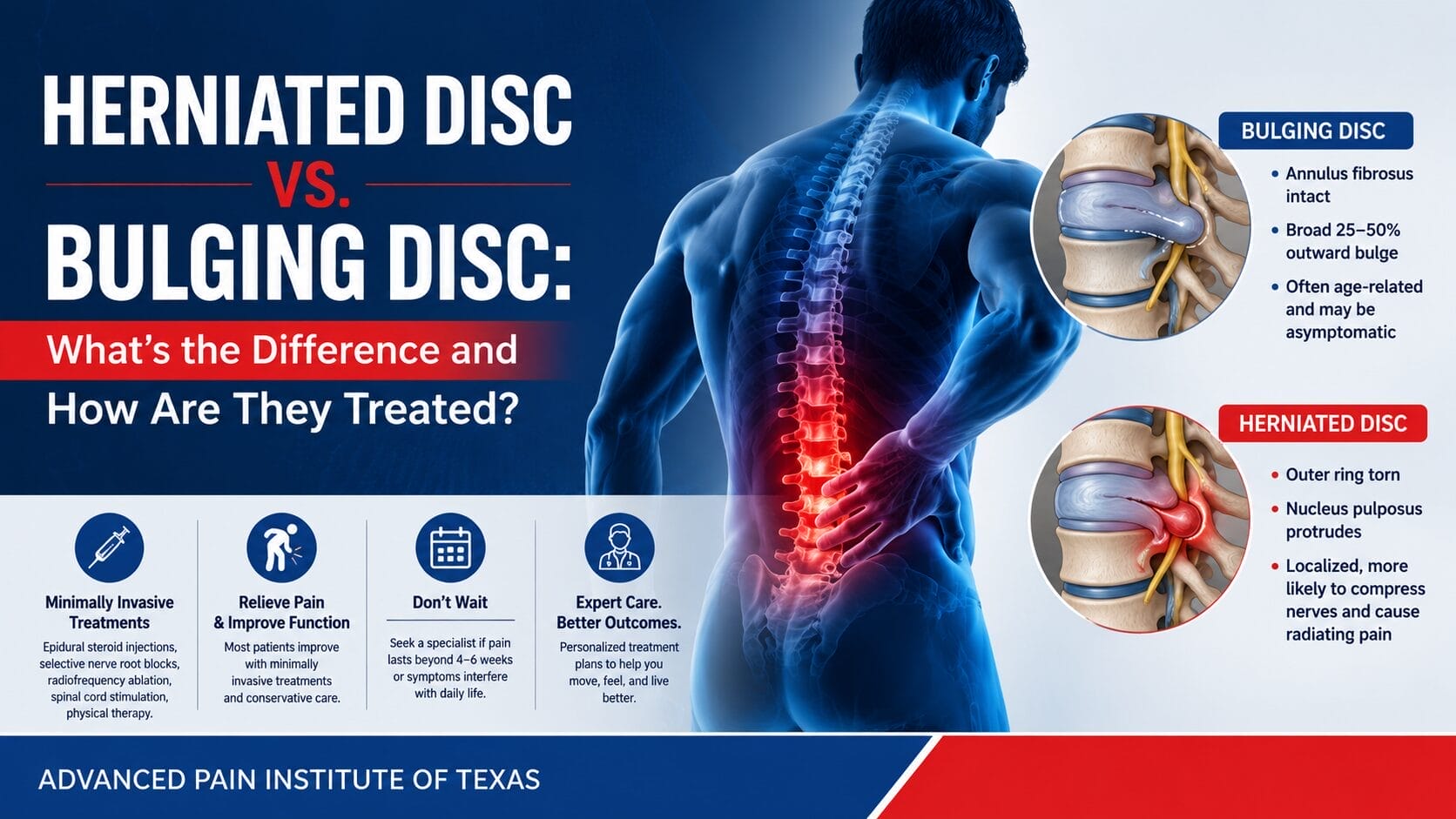
- Bulging disc: annulus fibrosus intact, broad 25–50% outward bulge; often age-related and may be asymptomatic.
- Herniated disc: outer ring torn; nucleus pulposus protrudes, localized, more likely to compress nerves and cause radiating pain.
- Most patients improve with minimally invasive treatments: epidural steroid injections, selective nerve root blocks, radiofrequency ablation, spinal cord stimulation, physical therapy.
- Seek a specialist if pain lasts beyond 4–6 weeks or you have radiating pain, numbness, weakness, or daily activity impairment.
Disc Problems: Two of the Most Common Spinal Conditions
If you’ve been told you have a “disc problem,” you’re not alone. Herniated discs and bulging discs are among the most common causes of back pain, neck pain, and radiating pain (such as sciatica) that we treat at Advanced Pain Institute of Texas.
While these terms are sometimes used interchangeably, they describe different types of disc damage — and the distinction matters for choosing the right treatment.
The Anatomy of a Spinal Disc
Spinal discs sit between each vertebra in your spine, acting as shock absorbers and allowing movement. Each disc has two parts:
- Annulus fibrosus — The tough, fibrous outer ring
- Nucleus pulposus — The soft, gel-like center
Problems occur when either the outer ring weakens or the inner material shifts out of position.
What Is a Bulging Disc?
A bulging disc occurs when the outer layer of the disc extends beyond its normal boundary, causing the disc to “bulge” outward — usually affecting a large portion (25–50%) of the disc’s circumference. Think of it like a hamburger patty that’s too big for the bun.
Key characteristics:
- The outer ring (annulus) remains intact
- The bulge is usually broad and symmetrical
- Often caused by aging and degenerative changes
- May or may not cause symptoms
- Very common — many adults have bulging discs on MRI with no pain at all
What Is a Herniated Disc?
A herniated disc (also called a ruptured or slipped disc) occurs when the outer ring cracks or tears, allowing the inner gel-like material to push through. This is more localized and more likely to compress nearby nerves.
Key characteristics:
- The outer ring is torn or cracked
- Inner disc material leaks or pushes outward
- Can be caused by injury, heavy lifting, or degeneration
- More likely to press on nerve roots, causing radiating pain
- More likely to cause significant symptoms than a bulging disc
Side-by-Side Comparison
| Feature | Bulging Disc | Herniated Disc |
|---|---|---|
| Outer ring (annulus) | Intact | Torn or cracked |
| Inner material | Stays contained | Pushes through the tear |
| Area affected | Broad, 25–50% of disc | Localized, focal protrusion |
| Nerve compression | Less likely | More likely |
| Pain severity | Mild to moderate | Moderate to severe |
| Common cause | Aging / degeneration | Injury, lifting, degeneration |
Symptoms to Watch For
Both bulging and herniated discs can cause similar symptoms, though herniated discs tend to produce more intense and specific nerve-related symptoms:
Lower Back (Lumbar Discs)
- Lower back pain
- Sciatica — shooting pain down the leg
- Numbness or tingling in the legs or feet
- Muscle weakness in the leg
Neck (Cervical Discs)
- Neck pain and stiffness
- Radiating pain into the shoulder, arm, or hand
- Numbness or tingling in the fingers
- Grip weakness
Non-Surgical Treatment Options
At Advanced Pain Institute of Texas, we take a minimally invasive approach to disc-related pain. Most patients find significant relief without ever needing surgery:
Epidural Steroid Injections
Epidural steroid injections are one of the most effective first-line treatments for disc-related nerve compression. Anti-inflammatory medication is delivered directly to the affected nerve root, reducing swelling and pain for weeks to months.
Selective Nerve Root Blocks
When we need to identify exactly which nerve a disc is affecting, a selective nerve root block provides both diagnosis and relief in one procedure.
Radiofrequency Ablation
If disc degeneration is contributing to facet joint pain alongside the disc problem, radiofrequency ablation can provide 6–18 months of relief by interrupting pain signals.
Spinal Cord Stimulation
For chronic disc-related pain — including failed back syndrome after previous disc surgery — spinal cord stimulation offers proven, long-term pain relief.
Physical Therapy & Core Strengthening
Targeted exercises to strengthen the muscles supporting the spine can reduce pressure on damaged discs and help prevent future problems.
When to See a Pain Management Specialist
You should seek professional evaluation if:
- Back or neck pain persists beyond 4–6 weeks
- Pain radiates into your arm or leg
- You experience numbness, tingling, or weakness
- Pain interferes with work, sleep, or daily activities
- Previous treatments (medications, physical therapy) haven’t helped
Get Expert Disc Treatment in the DFW Metroplex
Whether you’re dealing with a bulging disc, a herniated disc, or aren’t sure what’s causing your pain, our double board-certified physicians will find the source and create a personalized treatment plan. We serve patients from Dallas, Denton, Carrollton, and across the DFW Metroplex.
Take the first step toward relief. Call (972) 866-4246 or verify your insurance benefits online today.
Share this article
Related Posts


Understanding Spinal Stenosis: Symptoms, Causes, and Minimally Invasive Treatment in McKinney, TX



Follow us
A quick overview of the topics covered in this article.