What Is Cervicalgia? Your Neck Pain Diagnosis Explained
- Cervicalgia means pain in the neck; it's a symptom, not a specific diagnosis or proof of serious disease.
- Thorough evaluation uses history, exam, imaging review, and diagnostic blocks to identify the pain source; treatments span ergonomics to minimally invasive procedures.
- Seek urgent evaluation for progressive weakness, spreading numbness, loss of bowel or bladder control, fever, unexplained weight loss, or post-traumatic neck pain.
You go in for neck pain, and the visit summary comes back with a word you have never seen: cervicalgia. It looks serious. It sounds serious. Patients routinely leave the parking lot and type it into their phone with a knot in their stomach.
Here is the reassuring part, and it fits October’s theme perfectly — pain can be scary, but the facts usually are not. Cervicalgia simply means pain in the neck. “Cervic-” refers to the cervical spine, and “-algia” means pain. It is a clinical description, not a diagnosis of anything ominous.
That said, a description is not an explanation. October is Spine Health Awareness Month, so let us go further than the label and look at what actually causes neck pain, how it is properly evaluated, and what modern treatment looks like for Grapevine patients whose necks have been hurting far too long.
What Cervicalgia Means — And What It Does Not
Cervicalgia refers to pain localized to the neck, with or without stiffness and reduced range of motion. Notably, it is generally used for pain that stays in the neck.
When neck pain radiates down the arm with burning, tingling, or weakness, that is a different clinical picture called cervical radiculopathy — a nerve root in the neck is being compressed or irritated, and the symptoms follow that nerve’s territory into the shoulder, arm, or hand. The distinction matters because the workup and the treatment differ.
What cervicalgia does not mean: it does not mean a specific structure has been identified, it does not imply a serious underlying disease, and it does not mean surgery. It means the neck hurts and the source has not yet been named.
The Cervical Spine: A Lot of Engineering in a Small Space
Seven vertebrae support a head weighing 10 to 12 pounds while allowing more motion than any other part of the spine. Doing both jobs at once creates several potential pain generators:
- Facet joints — small paired joints guiding motion between vertebrae. They develop arthritic changes like any joint and are among the most common sources of persistent mechanical neck pain.
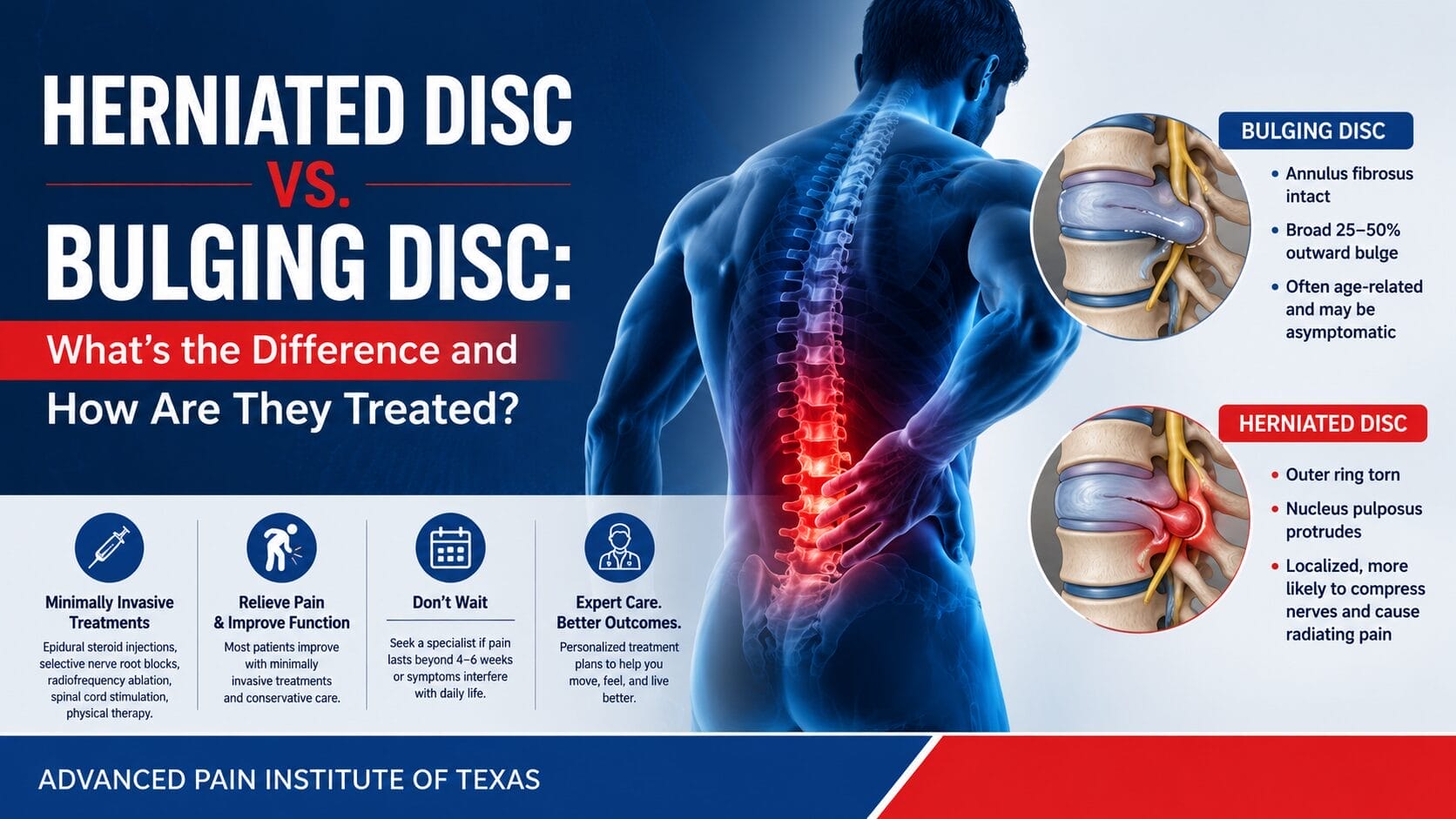
- Intervertebral discs — cushions between vertebrae that can bulge, herniate, or degenerate.
- Muscles and ligaments — strain, spasm, and trigger points, frequently posture-driven.
- Nerve roots — exiting nerves that can be compressed by disc material or bone spurs.
- The upper cervical segments — irritation here often refers pain into the head, producing what is called cervicogenic headache.
Because these structures sit within centimeters of each other and refer pain in overlapping patterns, identifying which one is responsible is genuinely a specialist skill — and it is the step most often skipped.
Common Causes We See in DFW Patients
Cervical facet arthropathy. Age-related wear in the facet joints, typically producing deep aching pain on one or both sides, worse with extension (looking up) and rotation, and often referring into the shoulder blade or the back of the head.
Degenerative disc disease. Discs lose height and hydration over time. This is nearly universal on imaging after 50 and often causes no symptoms at all — which is exactly why imaging findings must be matched to the physical exam rather than treated on their own.
Cervical herniated disc. Disc material extending beyond its normal boundary, potentially contacting a nerve root and producing arm symptoms.
Postural and occupational strain. Sustained forward head posture — laptops, phones, long commutes on 121 and 114 — dramatically increases load on the cervical spine and the muscles holding it up.
Whiplash-associated disorder. Following a motor vehicle collision, symptoms may take days to fully develop and can persist long after imaging looks normal.
Cervicogenic headache. Head pain generated by the neck. Frequently misdiagnosed as migraine for years, and it responds to entirely different treatment.
The Facts About the Things That Sound Scary
Most of the fear around neck pain attaches to the workup and the treatment options rather than the condition. So, plainly:
An MRI is not painful and involves no radiation. It is a magnet and radio waves. It is loud, and it requires lying still for 20 to 40 minutes. If enclosed spaces are difficult for you, say so in advance — that is a common, solvable problem, not an embarrassing one.
“Degenerative changes” on a report is not a catastrophe. Radiology reports describe everything they see. Studies of people with no neck pain whatsoever find disc degeneration in a majority of adults over 40. Findings are interpreted alongside your symptoms and exam, never in isolation.
Injections are not the same as surgery. A cervical injection is an outpatient procedure performed with local anesthetic and image guidance, usually taking 15 to 30 minutes, with most patients returning to normal activity the next day.
Seeing a pain specialist does not commit you to anything. Interventional pain physicians are diagnosticians first. A large share of what we do at a first visit is determine what is generating the pain — and a meaningful number of patients leave with a conservative plan and no procedure at all.
A pain specialist is not a medication dispensary. Modern interventional pain management is explicitly built around minimally invasive, targeted treatment as an alternative to escalating medication.
How Neck Pain Is Properly Evaluated
A thorough evaluation includes a detailed symptom history (quality, location, radiation, timing, triggers), a physical examination assessing range of motion, strength, reflexes, and sensation, a review of existing imaging, and often diagnostic blocks.
That last tool deserves attention because it is what separates targeted treatment from guesswork. If we suspect the facet joints, a small amount of local anesthetic is placed at the medial branch nerves supplying a specific joint. If your pain drops substantially for the duration of the anesthetic, that joint is confirmed as the source. If it does not, we have ruled it out and we look elsewhere. Few areas of medicine offer that kind of direct confirmation.
Treatment Options, From Least to Most Invasive
- Activity modification and ergonomics. Monitor at eye level, phone raised rather than head lowered, breaks every 30 minutes. Unglamorous and genuinely effective — our guide to building a pain-friendly ergonomic workspace covers the specifics.
- Physical therapy. Deep neck flexor strengthening and scapular stabilization address the mechanical cause rather than the symptom.
- Trigger point injections. For muscular components and persistent spasm.
- Cervical epidural steroid injection. Reduces inflammation around an irritated nerve root, typically for radicular arm symptoms.
- Medial branch block and radiofrequency ablation. When facet joints are confirmed as the source, radiofrequency ablation interrupts the pain signal from those specific joints, often providing six to twelve months of relief.
- Occipital nerve blocks. For cervicogenic headache and occipital neuralgia.
- Advanced neuromodulation. For select patients with persistent nerve pain who have not responded to other approaches.
Surgery has an important role in specific situations — progressive weakness, spinal cord compression, or structural instability. But it is not the default, and most patients with cervicalgia never need it. Our full range of interventional procedures is designed for exactly the space in between.
When Neck Pain Needs Prompt Attention
Seek evaluation promptly — or emergency care — if neck pain is accompanied by:
- Progressive weakness in an arm or hand, or dropping objects
- Difficulty with balance, walking, or fine motor tasks such as buttons
- Numbness or tingling that is spreading
- Loss of bowel or bladder control
- Fever, unexplained weight loss, or a history of cancer
- Neck pain following significant trauma
These are uncommon, but they change the urgency of evaluation.
Spine Health Awareness Month: Do Not Let a Word Stop You
If “cervicalgia” appeared on your paperwork, take the reassurance — it is a description of a symptom, not a verdict. Then take the next step, because a neck that has hurt for months has a source, and sources can be found.
Advanced Pain Institute of Texas treats neck, back, and spine pain for patients throughout North Texas, including Grapevine, Southlake, Colleyville, and Keller. Our board-certified physicians specialize in identifying the specific source of spine pain and treating it with the least invasive effective option.
Not sure what a first visit involves? Here is what to expect on your first visit — or request an appointment and let us take the mystery out of it.
This article is for educational purposes and is not a substitute for individualized medical advice.
Share this article
Related Posts


Understanding Spinal Stenosis: Symptoms, Causes, and Minimally Invasive Treatment in McKinney, TX


Follow us
A quick overview of the topics covered in this article.